Did you know? South Carolina is home to over 200+ Revolutionary War battles and skirmishes, many taking place right here in the Old 96 District!
See below for a timeline of notable Revolution events in the Old 96 District and how to visit them today.
November 1775
The first southern land battle of the Revolution was fought right here in Ninety Six, South Carolina! Whigs and Tories engaged in a battle on the South Carolina frontier at the Star Fort in Ninety-Six, South Carolina. Patriot Colonel Richard Richardson raised over 4,000 militiamen to subdue Loyalists in what became known as the Snow Campaign.
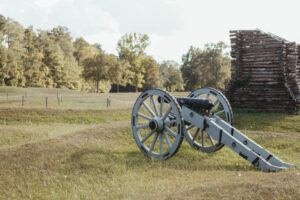
Today, you can visit Ninety Six National Historic Site, managed by the National Park Service, to learn about the settlers who lived here, the forts they built on either side of their town (including one replica fort and the original Star Fort that you can see today!), and what battle looked like in 1775 South Carolina. Explore the visitors center and museum, walk the one-mile paved & accessible trail through the battlefield, and more!
GPS Coordinates: 34.147140, -82.023410
July 1776
The signing of the Declaration of Independance
May 1777
After years of fighting between the Cherokees, who were allied with the British, and the Patriot settlers, the Treaty of DeWitt’s Corner was signed in Abbeville county near Corner Creek in 1777, ending the Second Cherokee War and ceding modern-day Anderson, Oconee, Greenville, and Pickens counties from the Cherokees to South Carolina. This treaty was negotiated in part by Andrew Pickens and was signed between representatives from South Carolina, Georgia, and Cherokee leaders such as Attakullakulla.
GPS Coordinates: 34.39721, -82.44278
February 1779
South Carolina Loyalist militia Col. James Boyd was raising men to fight southern Patriots. With about 500 men, Boyd captured the Patriot outpost at Broad Mouth Creek and burned Fort Independence. With Loyalist recruits in tow, Boyd intended to cross the Savannah River and join the British post at Augusta, Georgia. A few days later, Boyd was defeated, wounded, and died at the Battle of Kettle Creek. About half of Boyd’s men eventually reached the post at Augusta, only to find that the British had withdrawn to Savannah. Many of Boyd’s surviving recruits eventually joined the British in Savannah.
August 1780
At the Battle of Musgrove Mill, a turning point in the Southern Campaign of the Revolution, Patriots used the high ground and trees to their advantage for the win. Loyalists had gathered at Edward Musgrove’s Mill on the Enoree River. A small skirmish broke out, which alerted British officers and lured British troops into an ambush. Disorder set in and the British fled, leaving 63 dead, 90 wounded and 70 taken as prisoners. Very few Patriots were killed or wounded, and the battle proved that multistate cooperation amongst American Militia could defeat redcoat British regulars.
Today, you can visit Battle of Musgrove Mill State Historic Site to learn about the battle in their interactive visitor’s center, and walk the battlefield with educational signage throughout.
Hammond’s Old Store was the scene of an overwhelming Patriot victory on December 30, 1780. Col. William Washington led 280 cavalry and mounted militiamen, including the Little River Militia, to defeat an equal force of neighboring Tories. The battle resulted in 150 Tories killed or wounded, 40 captured, and 60 who escaped — with no Patriot casualties.
While the site of Hammond’s Store along the Bush River south of Clinton, South Carolina, is no longer visible to passersby, the Battle of Hammond’s Store, a relatively small military operation, set the stage for one of the major battles of the south: the Battle of Cowpens.
April 1781
The Battle of Mudlick Creek occurred in April of 1781. Lt. Col. Benjamin Roebuck and several hundred men of the Spartan Regiment attacked an unknown number of Tories at Fort Williams. The Patriots suffered several casualties, but the Loyalists were forced to abandon the fort. Lt. Col. Roebuck was wounded and captured during the battle.
October 1781
The skirmish at Pratt’s Mill was a Loyalist victory, fought on October 3rd, 1781 in present day Due West, SC. A group of Patriots led by John Norwood were encamped at this grist mill on Little River, and were attacked by the infamous “Bloody Bill” Cunningham, who bruned the mill, wounded Norwood, and scattered the Patriots.
The site is marked by a sign on the side of the river today.
GSP Coordinates: 34.30658, -82.44111
September 1783
The Treaty of Paris is signed, ending the Revolutionary War
Historical note: to the best of our ability, the above is an accurate description of events and locations. This page may be updated as more information becomes available.
We use cookies to ensure that we give you the best experience on our website. If you continue to use this site we will assume that you are happy with it.